Streamline Your Data Processes - Start a project!
Get customized solutions for your business - Try Our Services Today!
Streamline Your eCommerce Operations - Try Our Services Today!

Web3 Development Stack for Modern Dapps - 2025 Guide
The world of decentralized applications (dApps) is expanding at a breakneck speed with developers striving to implement Web3 solutions of the next generation. But then comes the challenges - building strong, secure & scalable dApps requires more than a knowledge of coding. On top of this, one needs proper Web3 development tools, along with a solid understanding of the entire tech stack.
Are you an experienced developer aiming at a transition into Web3? Or is your startup building its very first decentralized application? Whatever the case, the right development stack choice either feeds or wastes your project. With the ever-changing Web3 stack 2025, one must stay updated with modern tools & frameworks to achieve success.
This blog will introduce you to everything important in dApp development today. We'll take a journey through the important layers of Web3 architecture, look into today's most powerful development tools & provide practical insights to help you carry out well informed choices for your next project.
Understanding the Landscape of Web3 Development in 2025
The Web3 development ecosystem has surely matured in these recent years. Over the next five years, the global Web3 market is expected to grow by 49.3%, demonstrating a significant uptake & investment in decentralised technologies.
The Web3 development market is projected to grow from $4.43 billion in 2024 to $6.15 billion in 2025 & is expected to reflect a compound annual growth rate of approximately 38.9% by 2029 (source). These numbers highlight the incredible opportunity for developers & businesses entering the Web3 space.
What Makes dApp Development Different?
Traditional web applications require servers & databases. dApps work instead on blockchain networks, where backend logic is implemented through smart contracts & data is stored in a decentralized way. This fundamental difference requires a completely different approach to development.
Key characteristics of modern dApps include
-
Decentralization - No single point of failure
-
Transparency - All transactions are publicly verifiable
-
Immutability - Data cannot be altered once recorded
-
User ownership -Users are in charge of their digital assets & data.
-
Censorship resistance - The application cannot be shut down by a central authority.
Core Components of the Web3 Stack 2025
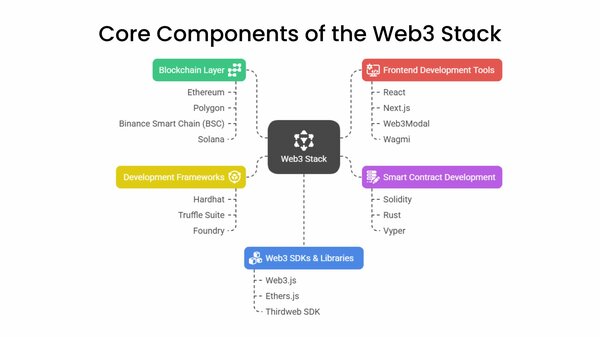
1. Blockchain Layer (Foundation)
The blockchain serves as the foundation of your dApp. Popular choices include
-
Ethereum - The most well known smart contract platform with the biggest developer community is Ethereum. Compatibility with Ethereum Virtual Machines (EVM) facilitates deployment over many networks.
-
Polygon- A Layer 2 scaling solution that gives you faster transactions & cheaper fees relative to Ethereum.
-
Binance Smart Chain (BSC) - High throughput at low transaction costs has somewhat made Popularity for DeFi Applications.
-
Solana - Known for its high speed transactions & growing ecosystem of developer tools.
2. Smart Contract Development
Smart contracts are the backbone of any dApp. Here are the essential tools
-
Solidity - The primary programming language for Ethereum & EVM compatible blockchains. It's object oriented & designed specifically for smart contract development.
-
Rust - It is ever more popular in blockchain development, especially on Solana & Polkadot networks.
-
Vyper- A Python style language prioritizing the security & readability of smart contracts on Ethereum.
3. Development Frameworks & Web3 development tools
Hardhat - Hardhat stands out as the most comprehensive Ethereum development framework. It offers deployment scripts, debugging tools & superior testing capabilities that expedite the development process.
Key features of Hardhat
-
Built in testing environment
-
Advanced debugging capabilities
-
Plugin ecosystem for extended functionality
-
Local blockchain simulation
Truffle Suite - A comprehensive development environment that includes
-
Truffle - Development framework for compiling & deploying smart contracts
-
Ganache - Personal blockchain for testing
-
Drizzle - Frontend libraries for connecting dApps to smart contracts
Foundry - Foundry is a lightning fast, portable toolkit for creating Ethereum applications in Rust.
4. Web3 SDKs & Libraries
-
Web3.js - The first JavaScript library programmed to interact with the Ethereum blockchain. Provides API for connecting to nodes, sending transactions & interacting with smart contracts.
-
Ethers.js - A more modern alternative to Web3.js, offering better documentation, TypeScript support & improved developer experience.
-
Thirdweb SDK - Comprehensive frameworks like Thirdweb & Scaffold ETH simplify Web3 development by providing pre built smart contract templates, authentication solutions, making it easier for developers to build & deploy dApps quickly.
5. Frontend Development Tools
-
React - The most popular choice for building dApp user interfaces. Its component based architecture works well with Web3 applications.
-
Next.js - Provides server side rendering & static site generation, which can improve dApp performance & SEO.
-
Web3Modal - A library that makes it easy to connect users' wallets to your dApp, supporting multiple wallet providers.
-
Wagmi - A collection of React hooks for Ethereum that simplifies wallet connections, contract interactions & transaction handling.
Infrastructure & Deployment Tools
Node Providers
-
Infura - Provides reliable access to Ethereum & IPFS networks without running your own nodes.
-
Alchemy- Provides improved APIs, real time notifications & debugging tools for Blockchain applications.
-
Alchemy - Offers enhanced APIs, real time notifications & debugging tools for blockchain applications.
-
QuickNode - Provides fast, reliable blockchain infrastructure with global presence & advanced analytics.
Decentralized Storage Solutions
-
IPFS (InterPlanetary File System) - The most popular decentralized storage solution for storing files, images & metadata.
-
Arweave - Offers permanent, immutable storage with a pay once, store forever model.
-
Filecoin - Provides incentivised decentralised storage with built in redundancy & retrieval guarantees.
Testing & Security Tools
-
Slither - A static analysis framework for Solidity that detects vulnerabilities & optimization opportunities.
-
MythX - A comprehensive security analysis platform for smart contracts.
-
OpenZeppelin - Provides secure, audited smart contract libraries & development tools.
-
Remix IDE - A browser based development environment with built in testing & debugging capabilities.
Modern crypto app architecture Patterns
Layer 2 Integration
In 2025, we might see an increase in AI, Layer 2 solutions & interoperability integrated into dApps. Layer 2 solutions like Polygon, Arbitrum & Optimism are becoming essential for scalable dApp architecture.
Benefits of Layer 2 integration
-
Reduced transaction costs
-
Faster confirmation times
-
Better user experience
-
Maintained security of the main chain
Microservices Architecture
Modern dApps often adopt a microservices approach where different components handle specific functions
-
Authentication service - Manages user wallet connections & authentication
-
Smart contract service - Handles blockchain interactions
-
Data indexing service - Processes & indexes blockchain data for faster queries
-
Notification service - Manages real time updates & alerts
API Design Patterns
RESTful APIs & GraphQL are commonly used to create clean interfaces between frontend applications & blockchain data. The Graph Protocol has become the standard for indexing & querying blockchain data efficiently.
Essential Development Workflow
1. Project Setup & Planning
Start by defining your dApp's core functionality & choosing the appropriate blockchain network. Consider factors like
-
Transaction costs
-
Network security
-
Developer ecosystem
-
Target user base
2. Smart Contract Development
Use frameworks like Hardhat or Foundry to
-
Write smart contracts in Solidity or Rust
-
Create comprehensive test suites
-
Deploy to testnets for validation
-
Perform security audits
3. Frontend Integration
Build your user interface using modern frameworks & integrate Web3 functionality
-
Implement wallet connection logic
-
Create contract interaction functions
-
Handle transaction states & errors
-
Design responsive, user friendly interfaces
4. Testing & Deployment
Follow a structured testing approach
-
Unit tests for individual functions
-
Integration tests for contract interactions
-
End to end tests for complete user flows
-
Security audits before mainnet deployment
Crypto Startup Considerations
There are some considerations for Crypto Startup development
Regulatory Compliance
Web 3.0 adoption is expected to rise by a CAGR of 44.5% by 2032, but startups must navigate evolving crypto regulations 2025 carefully. Consider
-
KYC/AML requirements for financial applications
-
Data privacy regulations like GDPR
-
Securities law compliance for token offerings
-
Regional restrictions & licensing requirements
Scalability Planning
Plan for growth from day one
-
Choose scalable blockchain networks
-
Implement efficient data storage strategies
-
Design for horizontal scaling
-
Consider cross chain compatibility
User Experience Focus
Success in Web3 depends heavily on user experience
-
Simplify wallet connection processes
-
Provide clear transaction feedback
-
Implement gas optimization strategies
-
Create intuitive onboarding flows
Integration with Traditional Systems
Many successful dApps combine Web3 features with traditional infrastructure. For companies offering Custom Mobile app development company services, integrating Web3 capabilities can provide competitive advantages.
Hybrid Architecture Benefits
-
Familiar user experience - Users can interact with Web3 features through familiar interfaces
-
Performance optimization - Critical functions can run on traditional servers while leveraging blockchain for specific use cases
-
Gradual adoption - Organizations can implement Web3 features incrementally
API Integration Patterns
Modern dApps often integrate with
-
Traditional payment processors
-
Cloud storage services
-
Analytics platforms
-
Customer support systems
Security Best Practices for Web3 Development
Security is paramount in Web3 development due to the immutable & high value nature of blockchain transactions.
Smart Contract Security
-
Audit your code - Use tools like Slither & MythX for automated analysis
-
Follow established patterns - Use OpenZeppelin libraries for common functionality
-
Implement access controls - Ensure only authorized users can call sensitive functions
-
Test thoroughly - Create comprehensive test suites covering edge cases
Frontend Security
-
Validate user inputs - Never trust data from external sources
-
Implement proper error handling - Gracefully handle failed transactions
-
Use secure communication - Always use HTTPS & validate SSL certificates
-
Protect private keys - Never store or transmit private keys in frontend code
Future Trends & Emerging Technologies
The Web3 development landscape continues to evolve rapidly. Key trends shaping 2025 include
1. Artificial Intelligence Integration AI is increasingly being integrated into Web3 applications for
-
Automated smart contract auditing
-
Predictive analytics for DeFi protocols
-
Enhanced user experience through AI powered interfaces
-
Automated trading & portfolio management
2. Interoperability Solutions Cross chain protocols are becoming essential for modern dApps
-
Polygon Bridge - Enables asset transfers between Ethereum & Polygon
-
Cosmos IBC - Facilitates communication between different blockchain networks
-
Polkadot Parachains - Allows specialized blockchains to share security & communicate
3. Sustainable Blockchain Solutions Environmental concerns are driving adoption of more sustainable blockchain networks
-
Proof of Stake consensus mechanisms
-
Carbon neutral blockchain initiatives
-
Energy efficient Layer 2 solutions
Custom Blockchain Development Considerations
For enterprises requiring specialized solutions, Custom Blockchain Development offers advantages like
-
Tailored consensus mechanisms - Choose algorithms that fit your specific use case
-
Custom tokenomics - Design economic models that support your business objectives
-
Enhanced privacy - Implement privacy features that meet regulatory requirements
-
Optimized performance - Fine tune network parameters for your application's needs
Performance Optimization Strategies
Building high performance dApps requires careful attention to optimization at every layer of the stack.
Gas Optimization Techniques
Smart contract efficiency directly impacts user experience & costs
-
Storage optimization - Use packed structs & minimize storage operations
-
Loop optimization - Avoid unbounded loops that can cause out of gas errors
-
Function modifiers - Use view & pure functions when possible to avoid gas costs
-
Batch operations - Combine multiple operations into single transactions
Frontend Performance
Modern dApp users expect responsive interfaces despite blockchain latency
-
State management - Use Redux or Zustand for efficient state updates
-
Caching strategies - Implement local caching for frequently accessed blockchain data
-
Progressive loading - Load critical features first, then enhance with additional functionality
-
Error boundaries - Graceful handling of blockchain connection issues
Choosing the Right Development Stack
Selecting the optimal Web3 development stack depends on several factors
1. Project Requirements
Consider your specific needs
-
Transaction volume - High throughput applications may benefit from Solana or BSC
-
Security requirements - Critical applications might prefer Ethereum's battle tested security
-
Budget constraints - Development & deployment costs vary significantly between networks
-
Time to market - Some frameworks offer faster development cycles
2. Team Expertise
Leverage your team's existing skills
-
JavaScript developers - Web3.js & Ethers.js provide familiar environments
-
Python developers - Brownie framework offers Python based smart contract development
-
Rust developers - Solana & Substrate provide native Rust development experiences
3. Developer Experience Optimization
Modern Web3 development tools prioritize developer experience through improved documentation, better error messages & streamlined workflows. Tools like Hardhat's console.log debugging & Foundry's built in fuzzing capabilities have revolutionized how developers build & test smart contracts.
Development Environment Setup - Setting up a proper development environment is crucial for productivity. Consider using
-
VS Code extensions - Solidity syntax highlighting & Intelli Sense
-
GitHub Copilot - AI powered code completion for smart contracts
-
Docker containers - Consistent development environments across teams
-
Continuous Integration - Automated testing & deployment pipelines
4. Long term Strategy
Plan for the future
-
Multi chain deployment - Choose tools that support multiple blockchain networks
-
Scalability needs - Consider Layer 2 solutions from the beginning
-
Community support - Larger communities provide better long term support & resources
Conclusion
The Web3 stack 2025 offers unprecedented opportunities for developers & businesses to build innovative, decentralized applications. With the right combination of tools, frameworks & best practices, you can create dApps that are secure, scalable & user friendly.
Success in Web3 development requires staying updated with rapidly evolving technologies, following security best practices & focusing on user experience. Whether you're building a simple DeFi protocol or a complex crypto regulations 2025 multi chain application, the tools & strategies outlined in this guide will help you navigate the Web3 development landscape effectively.
The future of the internet is decentralized & developers who master these technologies today will be well positioned to lead tomorrow's digital revolution. Start with small projects, experiment with different tools & gradually build your expertise in this exciting & rapidly growing field.
Ready to bring your Web3 vision to life?
Our team of experienced blockchain developers can help you navigate the complexities of decentralized application development. From smart contract creation to full stack dApp development, we provide end to end solutions tailored to your specific needs.
Contact us today to discuss your Web3 project & discover how we can help you build the next generation of decentralized applications.
Web3 Development Stack for Modern Dapps - 2025 Guide
The world of decentralized applications (dApps) is expanding at a breakneck speed with developers striving to implement Web3 solutions of the next generation. But then comes the challenges - building strong, secure & scalable dApps requires more than a knowledge of coding. On top of this, one needs proper Web3 development tools, along with a solid understanding of the entire tech stack.
Are you an experienced developer aiming at a transition into Web3? Or is your startup building its very first decentralized application? Whatever the case, the right development stack choice either feeds or wastes your project. With the ever-changing Web3 stack 2025, one must stay updated with modern tools & frameworks to achieve success.
This blog will introduce you to everything important in dApp development today. We'll take a journey through the important layers of Web3 architecture, look into today's most powerful development tools & provide practical insights to help you carry out well informed choices for your next project.
Understanding the Landscape of Web3 Development in 2025
The Web3 development ecosystem has surely matured in these recent years. Over the next five years, the global Web3 market is expected to grow by 49.3%, demonstrating a significant uptake & investment in decentralised technologies.
The Web3 development market is projected to grow from $4.43 billion in 2024 to $6.15 billion in 2025 & is expected to reflect a compound annual growth rate of approximately 38.9% by 2029 (source). These numbers highlight the incredible opportunity for developers & businesses entering the Web3 space.
What Makes dApp Development Different?
Traditional web applications require servers & databases. dApps work instead on blockchain networks, where backend logic is implemented through smart contracts & data is stored in a decentralized way. This fundamental difference requires a completely different approach to development.
Key characteristics of modern dApps include
-
Decentralization - No single point of failure
-
Transparency - All transactions are publicly verifiable
-
Immutability - Data cannot be altered once recorded
-
User ownership -Users are in charge of their digital assets & data.
-
Censorship resistance - The application cannot be shut down by a central authority.
Core Components of the Web3 Stack 2025
1. Blockchain Layer (Foundation)
The blockchain serves as the foundation of your dApp. Popular choices include
-
Ethereum - The most well known smart contract platform with the biggest developer community is Ethereum. Compatibility with Ethereum Virtual Machines (EVM) facilitates deployment over many networks.
-
Polygon- A Layer 2 scaling solution that gives you faster transactions & cheaper fees relative to Ethereum.
-
Binance Smart Chain (BSC) - High throughput at low transaction costs has somewhat made Popularity for DeFi Applications.
-
Solana - Known for its high speed transactions & growing ecosystem of developer tools.
2. Smart Contract Development
Smart contracts are the backbone of any dApp. Here are the essential tools
-
Solidity - The primary programming language for Ethereum & EVM compatible blockchains. It's object oriented & designed specifically for smart contract development.
-
Rust - It is ever more popular in blockchain development, especially on Solana & Polkadot networks.
-
Vyper- A Python style language prioritizing the security & readability of smart contracts on Ethereum.
3. Development Frameworks & Web3 development tools
Hardhat - Hardhat stands out as the most comprehensive Ethereum development framework. It offers deployment scripts, debugging tools & superior testing capabilities that expedite the development process.
Key features of Hardhat
-
Built in testing environment
-
Advanced debugging capabilities
-
Plugin ecosystem for extended functionality
-
Local blockchain simulation
Truffle Suite - A comprehensive development environment that includes
-
Truffle - Development framework for compiling & deploying smart contracts
-
Ganache - Personal blockchain for testing
-
Drizzle - Frontend libraries for connecting dApps to smart contracts
Foundry - Foundry is a lightning fast, portable toolkit for creating Ethereum applications in Rust.
4. Web3 SDKs & Libraries
-
Web3.js - The first JavaScript library programmed to interact with the Ethereum blockchain. Provides API for connecting to nodes, sending transactions & interacting with smart contracts.
-
Ethers.js - A more modern alternative to Web3.js, offering better documentation, TypeScript support & improved developer experience.
-
Thirdweb SDK - Comprehensive frameworks like Thirdweb & Scaffold ETH simplify Web3 development by providing pre built smart contract templates, authentication solutions, making it easier for developers to build & deploy dApps quickly.
5. Frontend Development Tools
-
React - The most popular choice for building dApp user interfaces. Its component based architecture works well with Web3 applications.
-
Next.js - Provides server side rendering & static site generation, which can improve dApp performance & SEO.
-
Web3Modal - A library that makes it easy to connect users' wallets to your dApp, supporting multiple wallet providers.
-
Wagmi - A collection of React hooks for Ethereum that simplifies wallet connections, contract interactions & transaction handling.
Infrastructure & Deployment Tools
Node Providers
-
Infura - Provides reliable access to Ethereum & IPFS networks without running your own nodes.
-
Alchemy- Provides improved APIs, real time notifications & debugging tools for Blockchain applications.
-
Alchemy - Offers enhanced APIs, real time notifications & debugging tools for blockchain applications.
-
QuickNode - Provides fast, reliable blockchain infrastructure with global presence & advanced analytics.
Decentralized Storage Solutions
-
IPFS (InterPlanetary File System) - The most popular decentralized storage solution for storing files, images & metadata.
-
Arweave - Offers permanent, immutable storage with a pay once, store forever model.
-
Filecoin - Provides incentivised decentralised storage with built in redundancy & retrieval guarantees.
Testing & Security Tools
-
Slither - A static analysis framework for Solidity that detects vulnerabilities & optimization opportunities.
-
MythX - A comprehensive security analysis platform for smart contracts.
-
OpenZeppelin - Provides secure, audited smart contract libraries & development tools.
-
Remix IDE - A browser based development environment with built in testing & debugging capabilities.
Modern crypto app architecture Patterns
Layer 2 Integration
In 2025, we might see an increase in AI, Layer 2 solutions & interoperability integrated into dApps. Layer 2 solutions like Polygon, Arbitrum & Optimism are becoming essential for scalable dApp architecture.
Benefits of Layer 2 integration
-
Reduced transaction costs
-
Faster confirmation times
-
Better user experience
-
Maintained security of the main chain
Microservices Architecture
Modern dApps often adopt a microservices approach where different components handle specific functions
-
Authentication service - Manages user wallet connections & authentication
-
Smart contract service - Handles blockchain interactions
-
Data indexing service - Processes & indexes blockchain data for faster queries
-
Notification service - Manages real time updates & alerts
API Design Patterns
RESTful APIs & GraphQL are commonly used to create clean interfaces between frontend applications & blockchain data. The Graph Protocol has become the standard for indexing & querying blockchain data efficiently.
Essential Development Workflow
1. Project Setup & Planning
Start by defining your dApp's core functionality & choosing the appropriate blockchain network. Consider factors like
-
Transaction costs
-
Network security
-
Developer ecosystem
-
Target user base
2. Smart Contract Development
Use frameworks like Hardhat or Foundry to
-
Write smart contracts in Solidity or Rust
-
Create comprehensive test suites
-
Deploy to testnets for validation
-
Perform security audits
3. Frontend Integration
Build your user interface using modern frameworks & integrate Web3 functionality
-
Implement wallet connection logic
-
Create contract interaction functions
-
Handle transaction states & errors
-
Design responsive, user friendly interfaces
4. Testing & Deployment
Follow a structured testing approach
-
Unit tests for individual functions
-
Integration tests for contract interactions
-
End to end tests for complete user flows
-
Security audits before mainnet deployment
Crypto Startup Considerations
There are some considerations for Crypto Startup development
Regulatory Compliance
Web 3.0 adoption is expected to rise by a CAGR of 44.5% by 2032, but startups must navigate evolving crypto regulations 2025 carefully. Consider
-
KYC/AML requirements for financial applications
-
Data privacy regulations like GDPR
-
Securities law compliance for token offerings
-
Regional restrictions & licensing requirements
Scalability Planning
Plan for growth from day one
-
Choose scalable blockchain networks
-
Implement efficient data storage strategies
-
Design for horizontal scaling
-
Consider cross chain compatibility
User Experience Focus
Success in Web3 depends heavily on user experience
-
Simplify wallet connection processes
-
Provide clear transaction feedback
-
Implement gas optimization strategies
-
Create intuitive onboarding flows
Integration with Traditional Systems
Many successful dApps combine Web3 features with traditional infrastructure. For companies offering Custom Mobile app development company services, integrating Web3 capabilities can provide competitive advantages.
Hybrid Architecture Benefits
-
Familiar user experience - Users can interact with Web3 features through familiar interfaces
-
Performance optimization - Critical functions can run on traditional servers while leveraging blockchain for specific use cases
-
Gradual adoption - Organizations can implement Web3 features incrementally
API Integration Patterns
Modern dApps often integrate with
-
Traditional payment processors
-
Cloud storage services
-
Analytics platforms
-
Customer support systems
Security Best Practices for Web3 Development
Security is paramount in Web3 development due to the immutable & high value nature of blockchain transactions.
Smart Contract Security
-
Audit your code - Use tools like Slither & MythX for automated analysis
-
Follow established patterns - Use OpenZeppelin libraries for common functionality
-
Implement access controls - Ensure only authorized users can call sensitive functions
-
Test thoroughly - Create comprehensive test suites covering edge cases
Frontend Security
-
Validate user inputs - Never trust data from external sources
-
Implement proper error handling - Gracefully handle failed transactions
-
Use secure communication - Always use HTTPS & validate SSL certificates
-
Protect private keys - Never store or transmit private keys in frontend code
Future Trends & Emerging Technologies
The Web3 development landscape continues to evolve rapidly. Key trends shaping 2025 include
1. Artificial Intelligence Integration AI is increasingly being integrated into Web3 applications for
-
Automated smart contract auditing
-
Predictive analytics for DeFi protocols
-
Enhanced user experience through AI powered interfaces
-
Automated trading & portfolio management
2. Interoperability Solutions Cross chain protocols are becoming essential for modern dApps
-
Polygon Bridge - Enables asset transfers between Ethereum & Polygon
-
Cosmos IBC - Facilitates communication between different blockchain networks
-
Polkadot Parachains - Allows specialized blockchains to share security & communicate
3. Sustainable Blockchain Solutions Environmental concerns are driving adoption of more sustainable blockchain networks
-
Proof of Stake consensus mechanisms
-
Carbon neutral blockchain initiatives
-
Energy efficient Layer 2 solutions
Custom Blockchain Development Considerations
For enterprises requiring specialized solutions, Custom Blockchain Development offers advantages like
-
Tailored consensus mechanisms - Choose algorithms that fit your specific use case
-
Custom tokenomics - Design economic models that support your business objectives
-
Enhanced privacy - Implement privacy features that meet regulatory requirements
-
Optimized performance - Fine tune network parameters for your application's needs
Performance Optimization Strategies
Building high performance dApps requires careful attention to optimization at every layer of the stack.
Gas Optimization Techniques
Smart contract efficiency directly impacts user experience & costs
-
Storage optimization - Use packed structs & minimize storage operations
-
Loop optimization - Avoid unbounded loops that can cause out of gas errors
-
Function modifiers - Use view & pure functions when possible to avoid gas costs
-
Batch operations - Combine multiple operations into single transactions
Frontend Performance
Modern dApp users expect responsive interfaces despite blockchain latency
-
State management - Use Redux or Zustand for efficient state updates
-
Caching strategies - Implement local caching for frequently accessed blockchain data
-
Progressive loading - Load critical features first, then enhance with additional functionality
-
Error boundaries - Graceful handling of blockchain connection issues
Choosing the Right Development Stack
Selecting the optimal Web3 development stack depends on several factors
1. Project Requirements
Consider your specific needs
-
Transaction volume - High throughput applications may benefit from Solana or BSC
-
Security requirements - Critical applications might prefer Ethereum's battle tested security
-
Budget constraints - Development & deployment costs vary significantly between networks
-
Time to market - Some frameworks offer faster development cycles
2. Team Expertise
Leverage your team's existing skills
-
JavaScript developers - Web3.js & Ethers.js provide familiar environments
-
Python developers - Brownie framework offers Python based smart contract development
-
Rust developers - Solana & Substrate provide native Rust development experiences
3. Developer Experience Optimization
Modern Web3 development tools prioritize developer experience through improved documentation, better error messages & streamlined workflows. Tools like Hardhat's console.log debugging & Foundry's built in fuzzing capabilities have revolutionized how developers build & test smart contracts.
Development Environment Setup - Setting up a proper development environment is crucial for productivity. Consider using
-
VS Code extensions - Solidity syntax highlighting & Intelli Sense
-
GitHub Copilot - AI powered code completion for smart contracts
-
Docker containers - Consistent development environments across teams
-
Continuous Integration - Automated testing & deployment pipelines
4. Long term Strategy
Plan for the future
-
Multi chain deployment - Choose tools that support multiple blockchain networks
-
Scalability needs - Consider Layer 2 solutions from the beginning
-
Community support - Larger communities provide better long term support & resources
Conclusion
The Web3 stack 2025 offers unprecedented opportunities for developers & businesses to build innovative, decentralized applications. With the right combination of tools, frameworks & best practices, you can create dApps that are secure, scalable & user friendly.
Success in Web3 development requires staying updated with rapidly evolving technologies, following security best practices & focusing on user experience. Whether you're building a simple DeFi protocol or a complex crypto regulations 2025 multi chain application, the tools & strategies outlined in this guide will help you navigate the Web3 development landscape effectively.
The future of the internet is decentralized & developers who master these technologies today will be well positioned to lead tomorrow's digital revolution. Start with small projects, experiment with different tools & gradually build your expertise in this exciting & rapidly growing field.
Ready to bring your Web3 vision to life?
Our team of experienced blockchain developers can help you navigate the complexities of decentralized application development. From smart contract creation to full stack dApp development, we provide end to end solutions tailored to your specific needs.
Contact us today to discuss your Web3 project & discover how we can help you build the next generation of decentralized applications.

Categories
- Digital Asset Management (DAM)
- Artificial Intelligence (AI)
- Product Information Management (PIM)
- E-commerce
- Master Data Management (MDM)
- Digital Experience Management
- Customer Data Platform
- Data Management Platform
- Recruitment
- Covid-19
- Digital Workspace
- Digital Experience Portal (DXP)
- Omnichannel Experience
- Pimcore
- Framework Comparison
- Software Development
- Learning Management Solution (LMS)
- CRM System
- Sales Portal
- Salesforce
- Blockchain Development
- App Development
- Technology
Latest Blogs
Similar Blogs

Building a Web3 App in 2025: Tech Stack, Tools & Tips
Remember the early days when the internet was seen as a temporary thing? Today, we're witnessing a s...
Read More
How to Build a Scalable Crypto Startup in 2025
2025 marks the greatest opportunity for entrepreneurs to build the best crypto startup development a...
Read More
Web3 Development Stack for Modern Dapps - 2025 Guide
The world of decentralized applications (dApps) is expanding at a breakneck speed with developers st...
Read More